


Relief Powder
Relief Powder
Results in 30 days or your money back — keep the product either way. Free standard shipping.
 100% money back guarantee
Couldn't load pickup availability
Relief is a premium, full-spectrum CBD powder formulated from U.S.-grown CBD hemp and processed in a CGMP certified facility in upstate New York. Quality is critical, we take immense pride in every step from seed to shipping, perform third-party testing for heavy metals, mold, etc., to ensure our product is highest level human-grade standards.
Relief is easy to use—just scoop and mix into your dog’s food. Perfect for picky eaters as there is almost zero taste or smell.
NOTE: Results are not immediate, typically pet owners see results within 3–4 weeks. It takes a couple of weeks of consistent dosing every day to see results. Every dog reacts differently, start with the recommended dosing, increase to up to double the dosing instructions if you observe your pet needs more.
Small Breed — Up to 20 lbs
½ scoop per 10 lbs · Serve twice daily
| Weight | Per Serving | Daily Total |
|---|---|---|
| Up to 10 lbs | ½ scoop | 1 scoop/day |
| 11–20 lbs | 1 scoop | 2 scoops/day |
Tip: Mix the powder in with wet or fresh dog food - if using dry dog food add a splash of broth to help the powder dissolve. Give it 3–4 weeks to see best results.
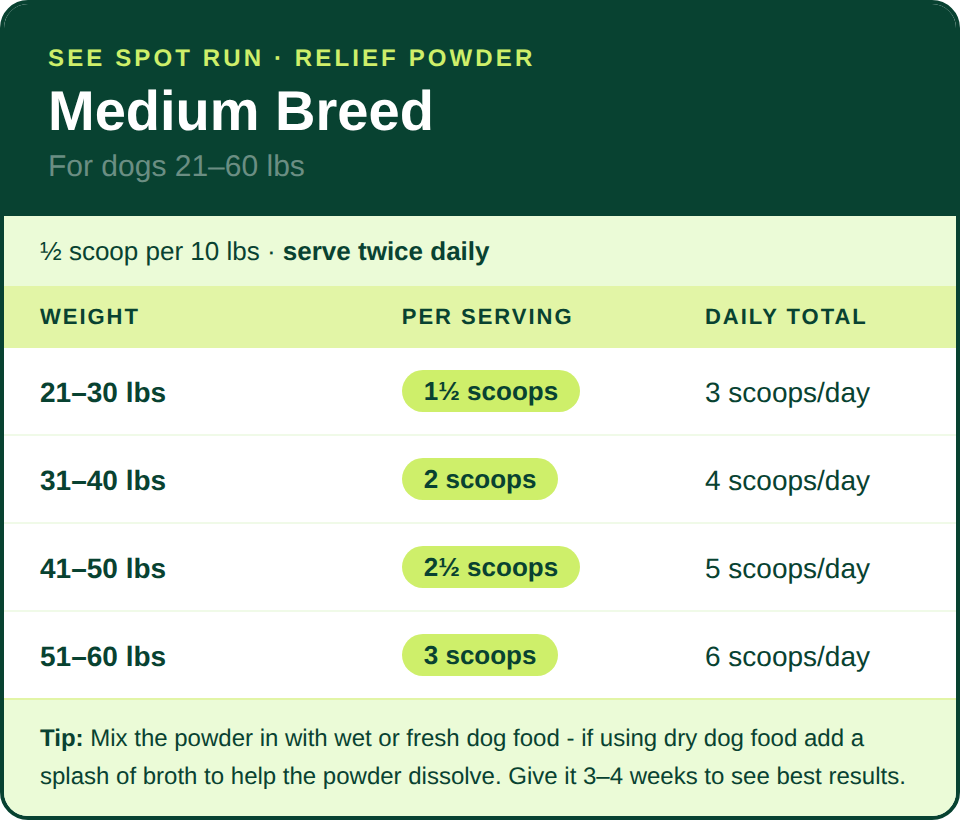
Medium Breed — 21–60 lbs
½ scoop per 10 lbs · Serve twice daily
| Weight | Per Serving | Daily Total |
|---|---|---|
| 21–30 lbs | 1½ scoops | 3 scoops/day |
| 31–40 lbs | 2 scoops | 4 scoops/day |
| 41–50 lbs | 2½ scoops | 5 scoops/day |
| 51–60 lbs | 3 scoops | 6 scoops/day |
Tip: Mix the powder in with wet or fresh dog food - if using dry dog food add a splash of broth to help the powder dissolve. Give it 3–4 weeks to see best results.
Large Breed — 61 lbs and up
½ scoop per 10 lbs · Serve twice daily
| Weight | Per Serving | Daily Total |
|---|---|---|
| 61–70 lbs | 3½ scoops | 7 scoops/day |
| 71–80 lbs | 4 scoops | 8 scoops/day |
| 81–90 lbs | 4½ scoops | 9 scoops/day |
| 91–100 lbs | 5 scoops | 10 scoops/day |
| 101–110 lbs | 5½ scoops | 11 scoops/day |
| 111–120 lbs | 6 scoops | 12 scoops/day |
| 121–130 lbs | 6½ scoops | 13 scoops/day |
| 131–140 lbs | 7 scoops | 14 scoops/day |
Tip: Mix the powder in with wet or fresh dog food - if using dry dog food add a splash of broth to help the powder dissolve. Give it 3–4 weeks to see best results.
Ingredients


How to serve in 3 easy steps!
STEP 1

Select your size
Small (10-20lbs)
Medium (21-60lbs)
Large (61lbs+)
STEP 2

Complete your order
Standard shipping is free!
STEP 3

Serve twice daily, mix in with their food
Pet parents report seeing results between 14-30 days. Be patient and consistent.
Published studies on CBD use on dogs:

FAQ's
What is CBD?
CBD stands for cannabidiol, an oil extracted from hemp plants. Hemp does NOT contain a significant amount of THC (tetrahydrocannabinol), which is the psychoactive component in marijuana.
Will CBD get my dog high?
CBD will NOT get your dog high. Hemp typically has no more than 0.3% THC. By contrast, Cannabis, which is the marijuana plant, contains ~12% THC (sometimes more depending on the genetics). For this reason, CBD oil is legally available in the US. Most common uses for the hemp plant is making fabric and paper.
My vet hasn't endorsed CBD, why is that?
Studies using CBD for therapeutic uses in pets have greatly increased in recent years, although there is still not enough for The Food and Drug Administration's Center for Veterinary Medicine (CVM) to endorse it.
What is the difference between CBD and Hemp?
There are many products in the market containing Hemp as a supplement for dogs. While hemp oil is extracted from hemp seeds, it contains minimal amounts of CBD, making it primarily a source of healthy fats and nutrients, but it does not offer the same therapeutic benefits as full spectrum CBD products.
When using full spectrum CBD, the effects of the various cannabinoids like CBD, CBG, and CBN when present together interact with each other to enhance the therapeutic effects on the dog's endocannabinoid system, potentially leading to better results when treating pain relief, anxiety reduction, slowing growth and reducing tumor size and improved overall wellness compared to isolated CBD.
Which health issues can CBD alleviate in dogs?
- Inflammation
- Anxiety / stress
- Enhanced / improved sleep quality
- Non-psycho-active (does NOT produce feelings of being "high")
- Short-term cognitive enhancement
- Skin problems
- Seizures
- Cancer cell slowed growth / reduction in size
- Joint Pain / Arthritis
How do you determine the dosing?
There are no current "hard and fast" rules, but there are some guidelines that have been used in veterinary studies and as a pet owner, we have given our dogs 2mg per 1lbs body weight. So for example, Gracie is 52 lbs and we give her ~25 mg in the morning and ~25 mg in the evening.
You may opt to give a smaller amount and build up over time ("low and slow" method of dosing) For example: 0.3mg/kg of CBD twice a day and gradually increase until you find the dose your dog responds to. If you do this it may take longer to see results.
How long does it take to see results or any improvement in my dog?
Most studies have been conducted with a minimum of 4 weeks treatment before measuring the effectiveness. This is due to the way the endocannabinoid system functions, it takes time to build up in the ECB system and see any effects.
How do I give it to my dog?
The easiest is just take a scoop and sprinkle it over their food AM and PM meals. We will sometimes add a little broth and mix it in but that is not necessary.
Why do you offer a powder instead of an oil?
We have used both oil and powder formulations in our pets, with great results. The reason we only offer a powder is simply because it has less odor and taste than the oil and is easier to mix in with the dog's food. Picky dogs were less interested in the oil, but have no problems taking it in powder form. It is the exact same CBD product, we developed a process to blend the oil with a product called N-Zorbit to turn it into a powder form.
I know someone that tried a CBD product and they did not see any improvements, so now I'm skeptical. Why does it work for some and not others?
Unfortunately, there are many companies selling CBD and CBN products out there for both humans and pets that are not using high quality CBD or CBN. They may be using just hemp derived oils, diluting it in some way, or even worse - sourcing the raw CBD materials from outside the US where there is no quality control and no regulations or testing to confirm the product is high quality, free of pesticides, herbicides, molds, heavy metals, etc. Our products are grown in our fields, using organic growing practices, are non-GMO and third party tested to ensure the highest possible quality end product. We always provide COAs (certificate of analysis) for our products and take great pride in managing the entire process end to end - "seed to shelf".
It is also important to note that a supplement is not a silver bullet and simply will not improve certain health issues. Again, we are not making any claims for health benefits, and are willing to guarantee a full re-fund if you don't see results. Talk to your vet, have them to call us if they want to talk about the product!
Can you share the studies and research on use of CBD and CBN on dogs?
Based on the available literature, Cornell's School of Veterinary medicine published that "there seems to be a place for hemp products in the treatment of osteoarthritis, atopic dermatitis and seizures."
One of the first CBD studies was done at Cornell, and it showed that CBD helped with pain management in many dogs. In the study, more than 80% of the dogs with osteoarthritis experienced a decrease in pain, allowing them to be more comfortable and active. One of the key reasons is CBD treatment helps with inflammation and pain which are the main symptoms of arthritis.
Colorado State University has an ongoing study on using CBD as an addition to epilepsy control in dogs. The goal, as with all seizure medications, is to gain control of seizure activity — reducing it as much as possible, while having minimal side effects and maintaining good quality of life. At this point, their research demonstrates that CBD used in combination with traditional seizure medications can be a successful approach.
Another study by the Australian animal therapeutics company CannPal tested a CBD product for its potential to help with dogs with atopy (a dermatologic/skin allergy resulting in itching and chewing). In the trial, dogs were randomly given a CBD product or a placebo for four weeks. The results were encouraging — showing 65% of the CBD dogs having at least a 50% decrease in itching and chewing. Of those dogs, half recovered from all signs of itchiness while being treated.
Other ongoing studies are also looking at how CBD could supplement cancer treatments, since it appears to be synergistic with some standard chemotherapy drugs. Working on its own, CBD may be able to affect cancer cell growth, but more research must be done.
CBD also shows promise for helping treat cancer directly. For example, CBD can slow the growth of and cause death to certain types of cancer cells grown in the lab.
One study showed that cell cultures from different types of canine cancers exposed to CBD oil showed a significant decrease in the reproduction of the cancer cells. The cancer types involved in this study were osteosarcoma, lymphoma, and mammary carcinoma. The study also showed that CBD combined with vincristine, a commonly used chemotherapeutic in veterinary medicine, had synergistic effects.
CBD is thought to have several properties, including being an anti-inflammatory, immune modulator, pain reducer, anti-seizure and anti-nausea support. CBD could be used to help dogs experiencing any of these symptoms. In both animals and humans, CBD has also been shown to be helpful with anxiety, insomnia, and chronic pain.
What is the endocannabinoid system?
The ECS comprises a vast network of chemical signals and cellular receptors that are densely packed throughout our brains and bodies. The "cannabinoid" receptors in the brain — the CB1 receptors — outnumber many of the other receptor types on the brain. They act like traffic cops to control the levels and activity of most of the other neurotransmitters. This is how they regulate things: by immediate feedback, turning up or down the activity of whichever system needs to be adjusted, whether that is hunger, temperature, or alertness.
To stimulate these receptors, our bodies produce molecules called endocannabinoids, which have a structural similarity to molecules in the cannabis plant. The first endocannabinoid that was discovered was named anandamide after the Sanskrit word ananda for bliss. All of us have tiny cannabis-like molecules floating around in our brains. The cannabis plant, which humans have been using for about 5,000 years, essentially works its effect by hijacking this ancient cellular machinery.
(Source: https://www.health.harvard.edu/blog/the-endocannabinoid-system-essential-and-mysterious-202108112569)
Do you make products for other pets like Cats or Horses?
Right now we are focusing on dogs, because this has been our personal experience with our own pet dogs Ketch and Gracie, but there are many studies that show similar results in cats and horses. We are in the process of developing products to help other pets and hope to release these soon!
Are there any dangers or potential drug interactions when using CBD in dogs?
We recommend you consult with your Veterinarian. Just be aware that in some states, vets are not allowed to endorse, recommend, or condone the use of CBD in dogs as the FDA has not produced its endorsement of CBD usage to date. Some studies caution that using CBD in combination with the following veterinary drugs could cause a reduction in their efficacy:
- steroids such as prednisone
- tramadol
- Amitriptyline
- Immunotherapy
Sources: